
Kershaw County Bench Warrants Explained
A bench warrant comes from a judge, and it grows out of a court obligation rather than a new criminal charge. Kershaw County's official paperwork describes one common path as failure to appear after bond, though a judge can also issue these warrants for a failure to comply or to pay. That makes it different from an arrest warrant, which needs fresh probable cause for a new offense. The issuing court and the underlying case control what happens next. Records split across Magistrate, Camden, Elgin, Bethune, General Sessions, and Family Court, and Kershaw County posts no complete public bench-warrant list. Your best move is simple: call the court printed on the citation, bond paper, or docket, and turn to the KCSO Warrants Division only if you need details about service.
Kershaw County FTA Bench Warrant Form SCCA523
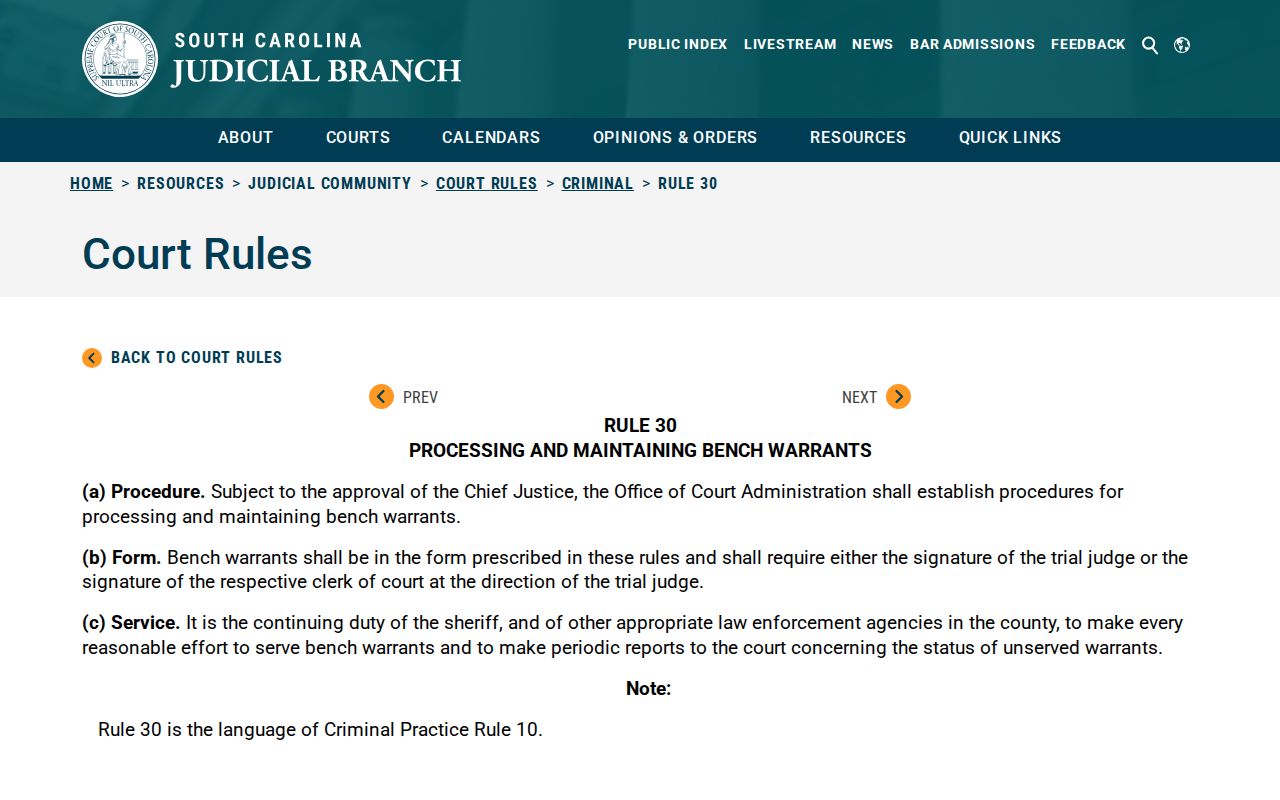
South Carolina form SCCA523 carries the title Bench Warrant after Failure to Appear, and it is the paperwork behind many Kershaw County bench warrants. The form records the county, case number, party, FTA date or reason, judge, court address, service certification, and officer return. Its command sends the person into custody and before the court within 24 hours. The blank form explains the process; a filled-out warrant is an official record. Criminal Practice Rule 30 governs how these warrants are processed, requiring sheriffs and other agencies to make reasonable efforts at service and to report status back to the court. You can view the blank SCCA523 form to see its field layout.
In Kershaw County, the form backs the service process. It does not create an online warrant search or promise an arrest time.
How Kershaw County Bench Warrants Are Issued
One missed date does not trigger the same paperwork in every case. SCCA523 ties a Kershaw County bench warrant to a failure to appear in violation of a bond already set. A failure to appear on a summons can also support a warrant under S.C. Code §22-5-115 once the legal conditions are met. Family Court works from its own form, SCCA413, which lists failure to appear, failure to comply, failure to pay, or other reasons. A bond violation may add forfeiture or surety surrender to the mix. The judge and the case type decide which rule fits.
Note: A bench warrant describes a court process, not the final outcome of the underlying case.
Kershaw Magistrate Warrant Starts in Room 202
The Kershaw County Magistrate Court sits in Room 202 of the courthouse at 1121 Broad Street in Camden. It handles lower-level criminal and traffic matters, bail, preliminary hearings, and arrest or search warrants. Its clerk can pull the right summary-court file and tell you whether an appearance or bond question belongs before a magistrate. General Sessions records live with the Clerk of Court in Room 313, and Bond Court is listed in Room 118. The Sheriff's headquarters sits in Lugoff, away from the courthouse, so confirm the office and room before you drive. Camden, Elgin, and Bethune Municipal Courts run their own dockets for city cases; a city citation goes to the court printed on it.
Bench Warrants and Arrest Warrants Compared
The trigger separates these two records. A Kershaw County bench warrant follows a court event or order, while an arrest warrant starts with a law-enforcement request and a judge's probable-cause review under South Carolina procedure.
| Record | Common trigger | Kershaw route |
|---|---|---|
| Bench warrant | FTA, failure to comply, bond issue, or other court order | Issuing Magistrate, municipal, Circuit, or Family Court |
| Arrest warrant | Sworn request and probable-cause finding | Magistrate, municipal, Circuit judge, or serving agency |
| Search warrant | Authority to search property or a place | Issuing judge and law-enforcement agency |
A search warrant, by contrast, is not an arrest order at all. And a Kershaw County FTA bench warrant needs no new probable-cause affidavit for a new offense.
Kershaw Family Court Bench Warrant Route
Family Court matters in Kershaw County, including support, custody, contempt, or a missed appearance, do not travel the ordinary General Sessions route. Form SCCA413 has separate boxes for failure to appear, failure to comply, and failure to pay, plus jail-notification and service fields. Family records can stay confidential, especially where juveniles are involved, so use the Fifth Circuit Family Court, the Clerk, or an attorney to find the right file. A Kershaw Public Index result may not show the full family warrant document. Do not send a blanket request to the Sheriff's Office and assume it reaches the family docket: KCSO FOIA covers sheriff-held records only, and court access runs through the court.
Resolving a Kershaw County Bench Warrant
Call the issuing clerk and KCSO before you appear. Ask whether the judge allows a new date, counsel-arranged appearance, motion to recall or quash, walk-through surrender, or bond posting. Kershaw County publishes no local recall form, filing fee, or universal surrender window.
- Identify the court, case number, and missed setting.
- Ask whether an attorney can request a reset or recall.
- Confirm bond amount and type, where it is accepted, and whether a judge must see the person.
- If surrender is directed, confirm booking and the next bond hearing.
- Get an order, receipt, or docket entry and ask who updates the service record.
Do not assume that paying a fine recalls an FTA warrant. Get confirmation from the issuing court.
Kershaw County's home page lays out warrant resolution steps for bond, court confirmation, and records after an appearance.
Kershaw Bench Warrant Bond Windows
The Detention Center FAQ lists city judge windows every day from 7:30-8:00 a.m. and 3:30-4:30 p.m. County magistrate bond hearings are listed at 8:00 a.m. Monday through Friday and 4:00-5:00 p.m. daily. Times shift, so call (803) 425-1516, option 1. Kershaw County says hearings happen in the front lobby and urges arriving 15-20 minutes early. Those windows do not create a walk-in surrender process. Ask the issuing court or the Warrants Division where to report, and whether the person will be booked or held for a hearing. A cash or surety bond covers release conditions only; the pending case goes on. The county publishes no countywide bond schedule or online jail bond portal.
Finding the Court That Issued the Warrant
Your paperwork tells you where to look. The citation, bond, summons, or docket notice names the issuing court and the case number. Circuit and General Sessions files belong to the Kershaw County Clerk of Court at (803) 425-7223, while magistrate and traffic matters run through (803) 425-7226. Camden Municipal Court sits behind (803) 432-2421 ext. 1120. Elgin uses (803) 438-2362, and Bethune uses (843) 334-6238. Federal cases take a different path entirely: Kershaw County matters land in the Columbia Division, not a county courthouse, so status comes from the federal clerk, PACER, USMS, or your counsel. Not sure which court issued the warrant? Call the KCSO Warrants Division at (803) 425-1512 and ask where it should be confirmed.
Payment and Recall for Kershaw Bench Warrants
Paying off a balance is only the first step. A receipt proves the money moved, yet a failure-to-appear order may still need a judge or a separate recall before the bench warrant dies. A bond can get someone released, but the case itself stays pending in Kershaw County court. A surety surrender puts a person back in custody without resolving the underlying charge. So after any payment, bond, or surrender, ask the court directly whether it entered a recall, set a new date, or changed the bond terms. Get the docket entry or written order and keep it. One more caution: a cleared warrant is not an expunged case, and the Public Index can lag behind the clerk's records. South Carolina expungement rules do cover bench warrants tied to eligible dismissed or not-guilty summary charges, and only the court, not a private search service, runs that process.